


Kitchen in the box Food Processor: A Dual-Bowl Chopper and Grinder Explained
The Kitchen in the box Food Processor is a compact electric kitchen appliance that combines three jobs in one footprint: it works as a meat grinder, a vegetable chopper, and a small food processor. This particular configuration stands out because it ships with two 8-cup bowls and two bi-level blade sets, a setup that shapes how the appliance fits into daily cooking rather than just how much it can hold.
Understanding what this machine is designed to do — and, just as importantly, what it is not — makes it easier to decide whether it belongs on your counter. Below is a breakdown of its design, controls, cleaning routine, and the kind of kitchen it suits.
Design and Build Quality
The most distinctive design decision here is the dual-bowl arrangement. Rather than a single work bowl, the unit includes two separate 8-cup bowls. According to the manufacturer, this separation is intended to keep raw and cooked foods isolated from one another, which supports better hygiene and health practices during meal prep. For anyone who has juggled a single bowl between chopping raw chicken and prepping vegetables, that logic is easy to follow.
Storage is addressed as well: the two bowls can be stacked, which helps conserve cabinet or counter space when the appliance is not in use. The motor base is described as wiping clean easily, while the detachable parts are stated to be dishwasher-safe — a practical combination that reduces hands-on cleanup time.
The unit is finished in black, and the overall format is a countertop chopper rather than a full-size processor tower. The 8-cup capacity positions it toward family-sized batches rather than single servings.
Features and Technology
At the center of the appliance is a 400W all-copper motor. The manufacturer states that this motor powers the chopping, mixing, and grinding functions and can complete those tasks in seconds. That is a stated product claim rather than an independently verified result, but it indicates the intended speed of operation.
Two sets of S-blades are included, described as bi-level blades. The manufacturer states that this blade design delivers faster and finer results. Again, this is the brand’s characterization of the blades’ performance rather than a measured outcome.
The control scheme is deliberately simple: two speed settings. There are no complex presets or digital menus to navigate, which keeps the learning curve short.
Two-Speed Control and How to Use It
The two buttons are assigned to different categories of food, and the manufacturer provides specific guidance for each.
- Button I is intended for regular vegetables and coarse-cut ingredients. The suggested method is to hold the button for about three seconds, then repeat for three to four cycles to process the food.
- Button II is designed for meat grinding and tougher foods. Here the recommendation is to hold for five to six seconds and repeat for three to four cycles to finely chop or mince.
This pulsed, cycle-based approach is worth noting because it differs from simply running the machine continuously. Following the stated intervals gives you more control over texture, letting you stop at a coarse chop or continue toward a finer mince depending on the ingredient and the result you want.
Performance and Everyday Experience
The appliance is positioned as a multi-task tool: it chops, mixes, and grinds. The manufacturer lists meat, fish, vegetables, and baby food among the intended uses, and the two blade sets support switching between those jobs. Because there are two bowls, you can theoretically keep one dedicated to raw proteins and another for produce or cooked items without cross-contamination between batches — the hygiene benefit the dual-bowl design is built around.
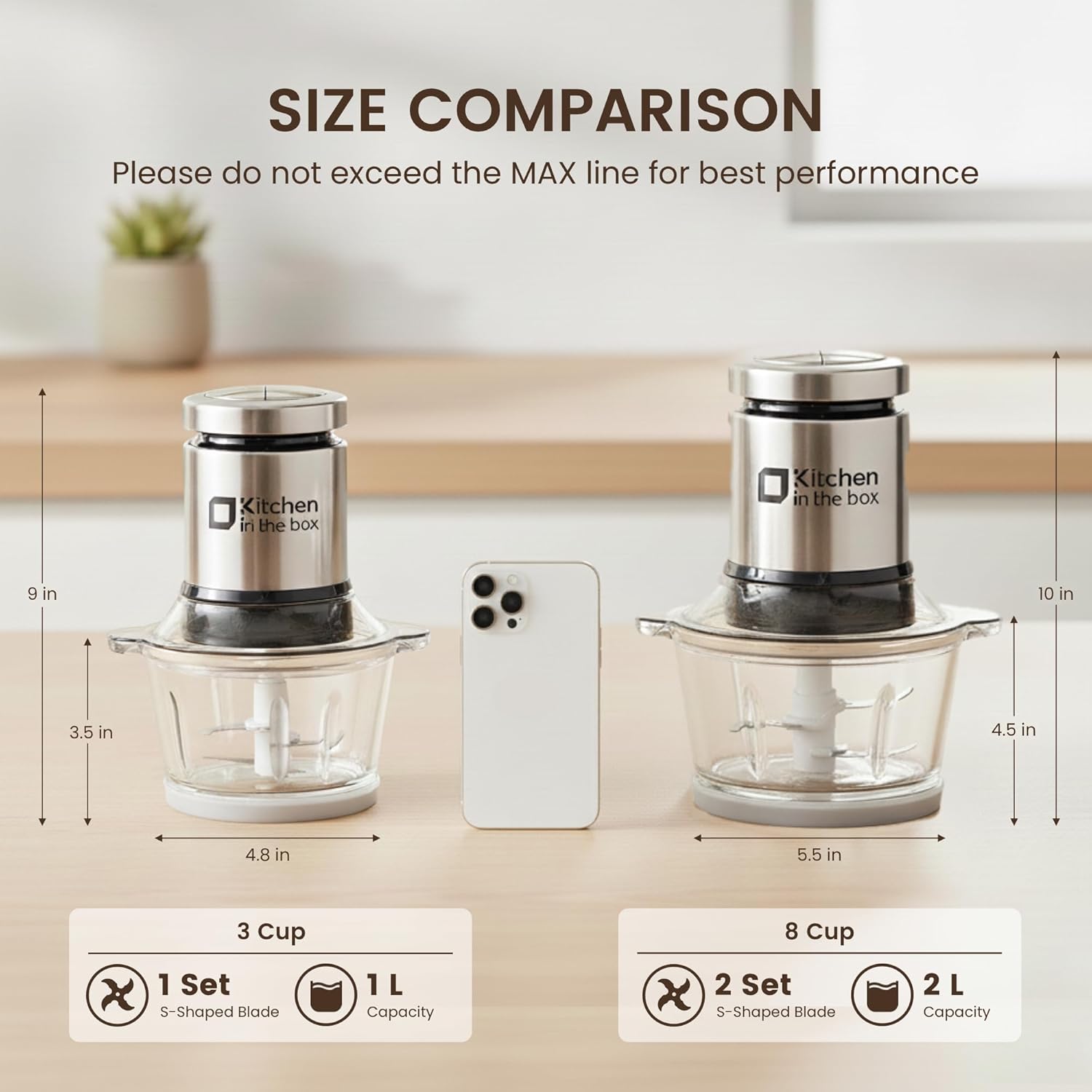
With an 8-cup capacity in each bowl, the machine is sized for preparing larger quantities at once, which aligns with the manufacturer’s description of it as designed for families, group gatherings, and home meal prep. If your typical cooking involves chopping for a single portion, this capacity may be more than you need; if you regularly prep in bulk or cook for several people, the volume is a better match.
It is worth being clear about what the supplied information does not establish. There are no stated results for noise level, processing time for specific ingredients, or how the motor performs under extended use. The manufacturer’s claims about speed and fineness are just that — claims — and should be treated as the brand’s description rather than a guarantee.
Cleaning, Storage, and Compatibility
Cleanup is one of the more clearly defined aspects of this product. The detachable components are dishwasher-safe, and the motor base is described as easy to wipe clean. Since the motor base is the part that cannot be submerged, keeping the detachable parts separate for the dishwasher simplifies the routine considerably.
Storage is helped by the stackable bowl design, which means the two bowls do not require double the shelf space. For kitchens with limited cabinet room, that is a meaningful detail.
The manufacturer also references a second model in the same line: a 3-cup version intended mainly for small-batch ingredients such as garlic mince, chopped onions, small portions of baby food, dips, and toddler food. That distinction is useful context. The 8-cup dual-bowl unit reviewed here is the larger, family-oriented option, while the 3-cup model serves smaller, more targeted tasks. Buyers comparing the two should base the choice on batch size and how often they cook for groups versus individuals.
Who Is This Product Best For?
Based on the manufacturer’s stated design intent, this food processor suits households that prepare meals in larger quantities. The 8-cup bowls and the emphasis on family cooking, group gatherings, and home meal prep point toward people who chop, grind, and mince regularly rather than occasionally.
The dual-bowl setup is particularly relevant for anyone who wants to keep raw and cooked ingredients in separate vessels during a single prep session. Home cooks working with meat, fish, and vegetables in the same meal may find that separation useful.
It is also a reasonable fit for those who prefer a straightforward two-button control scheme over programmable settings, and for anyone who values dishwasher-safe detachable parts and stackable storage. Conversely, someone cooking mostly for one or two people, or who only needs occasional garlic mincing, may find the smaller 3-cup model in the same line more proportionate to their needs.
Final Verdict
The Kitchen in the box Food Processor is a family-oriented electric chopper and grinder built around a 400W all-copper motor, two speed settings, and a dual 8-cup bowl design. Its strongest practical ideas are the separation of raw and cooked foods through two bowls, the inclusion of two bi-level S-blade sets, and a cleaning routine that combines dishwasher-safe detachable parts with a wipe-clean base.
The two-button, cycle-based control scheme is simple to learn, and the manufacturer provides specific hold times and repetition counts for each speed. Capacity and stackability make it a sensible choice for larger households and batch prep, while the existence of a smaller 3-cup model in the same range gives buyers a clear alternative if the 8-cup size is more than their cooking requires.
What the available information does not provide is verified performance data, so claims about speed and fineness should be read as the manufacturer’s own descriptions. On the strength of its stated design, features, and intended uses, this is a coherent option for households that want a single countertop appliance to handle chopping, grinding, and mincing in family-sized quantities.